


A user passes identity verification once. A week later, their passport scan, selfie, address details, and screening results may exist in several places they have never heard of: the verification provider, the relying platform, an internal dashboard, a support tool, maybe a backup system as well.
That is still a normal outcome in digital identity.
From where we sit, this is the part people underestimate. Teams spend a lot of time comparing coverage, API quality, pass rates, and pricing. Those things matter. But they are downstream questions. The harder question comes earlier: after verification is done, what should the platform actually receive?
In many traditional flows, the answer is some form of copy. Sometimes it is the raw document. Sometimes it is extracted PII plus a verification record. Sometimes it is a package that the platform can retrieve later. The format changes. The model does not. Sensitive user data moves, gets stored, and becomes someone else's long-term responsibility.
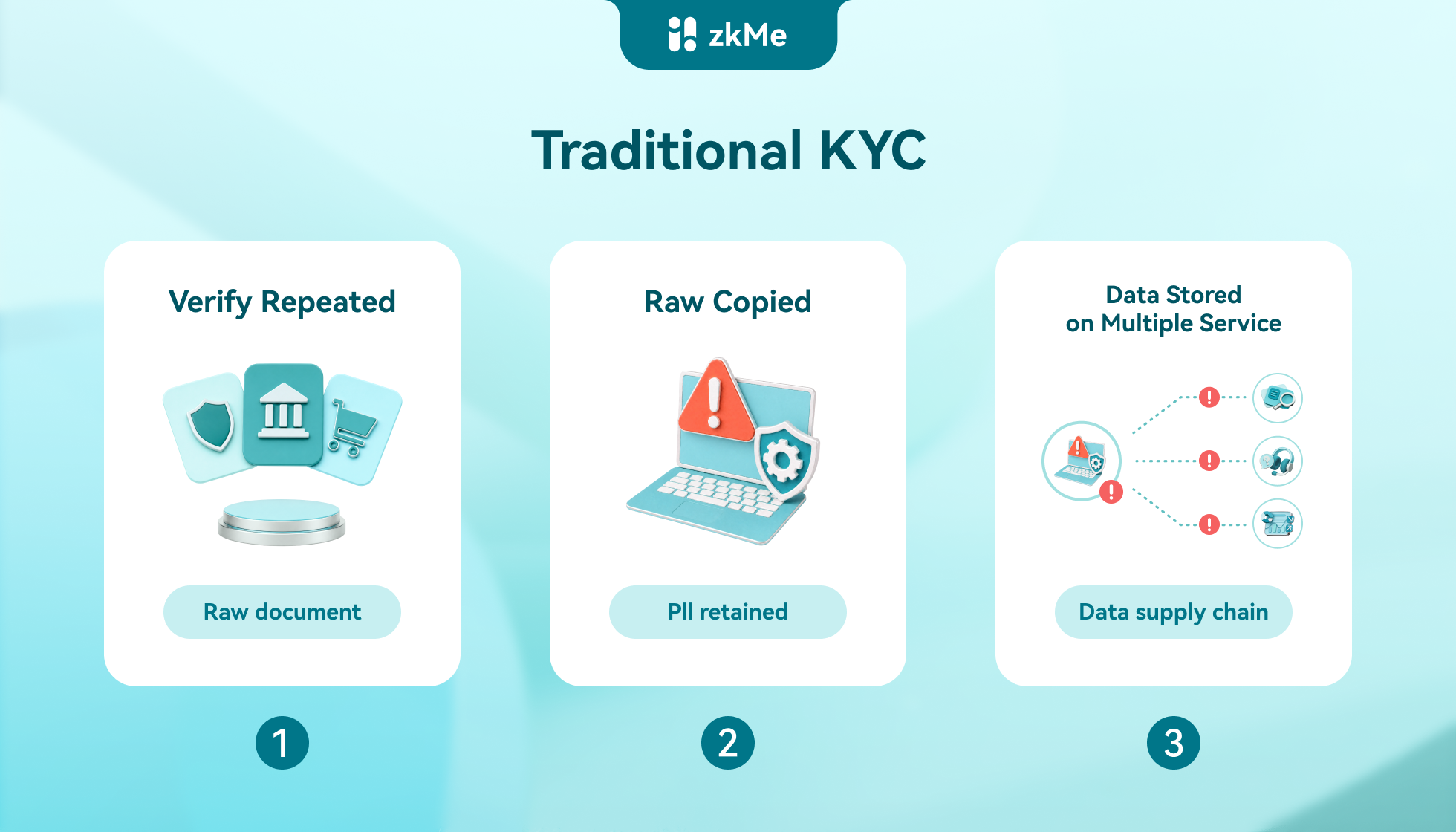
A proof-based model starts from a cleaner idea. The platform should receive evidence that the required condition has been met, without having to take custody of the full underlying record.
That sounds like a technical distinction. It is not. It changes the security model, the compliance posture, the user experience, and what identity infrastructure looks like at scale.
The real choice happens after the check
Most identity discussions start in the wrong place. They start with vendors.
Which provider has the broadest document coverage? Which one supports the markets we care about? Which SDK will our team hate the least? Those are fair buying questions, but they assume the basic model is fixed.
It is not.
The real choice is whether your verification system depends on copying user data into every platform that needs to trust the result, or whether it can work from verifiable proofs instead. That difference matters far more than the logo on the contract.
This is especially obvious in products that need repeated trust decisions: financial onboarding, access control, eligibility checks, account ownership proofs, credential-based services, and systems where users move across multiple products over time. In those settings, raw documents are a clumsy unit of trust. They are heavy, hard to secure, and too easy to duplicate.
Where the old model starts to break
Traditional identity verification grew up in a more centralized environment. A user submitted documents. A provider checked them. A platform stored the result, often along with the underlying material, because that felt safer and more operationally convenient. If the platform held the data itself, it could re-run checks, respond to support requests, and satisfy audit expectations from one place.
The problem is that convenience compounds.
Once a relying party stores identity data, other systems tend to form around it. Customer support wants access. Operations wants access. Risk tools want access. Data teams want structured fields. Backups preserve everything. The original identity check becomes the beginning of a data supply chain.
That is where the model starts to show strain. The issue is not simply that one vendor may get breached. The bigger issue is that the system keeps producing new copies of highly sensitive data because that is how the workflow was designed in the first place.
We see this as the central weakness of copy-based verification. It solves trust by spreading data around.
Breach surface is the problem people feel too late
Security teams already know this, but product and growth teams often feel it later, when the system is harder to change.
Every additional storage point increases the breach surface. Every internal interface that can reveal identity records creates another access-control problem. Every downstream dependency adds another place where data can leak, be over-retained, or be used outside its narrow purpose.
Users feel this too, even if they do not use the term "breach surface". They experience it as unease. Why am I uploading this again? Why does this app need all of this? Where is this going? Who keeps it? For how long?
Those are reasonable questions. In many cases, the platform only needs one answer: is this person eligible? Not their full document set. Not a permanent copy of their identity pack. Just a reliable yes for a specific claim.
That gap between what the platform needs and what it collects is where a lot of today's identity friction comes from.
Data minimization is no longer a side issue
For a long time, data minimization was treated as a policy principle that legal or privacy teams would sort out after the system was already built. That approach is getting harder to defend.
In practice, the question is now architectural: what data do we truly need to move, expose, and retain in order to make a trust decision?
If a service only needs to know that a user is over 18, then a stored date of birth is excess. If a platform only needs to know that a user is resident in an approved jurisdiction, then retaining a full proof-of-address package creates more responsibility than value. If a business only needs to confirm that an account belongs to a real person who passed screening, then broad document custody starts to look like baggage.
This is where proof-based verification becomes useful in a very concrete way. It narrows the exchange. The platform gets the fact it needs. The user does not have to hand over the whole file every time.
That is not a softer form of compliance. It is a more exact one.
What proof-based verification actually changes
A proof-based model does not skip identity checks. The hard work still happens. Documents can still be validated. Screening can still take place. Risk rules can still apply. The difference is what leaves that process.
Instead of passing raw documents or broad identity data downstream, the verifier issues a credential, attestation, or proof that another system can verify. In a zero-knowledge model, that proof can confirm a claim without exposing the underlying information used to establish it.
This matters because many trust decisions are narrower than the data packages traditionally used to support them.
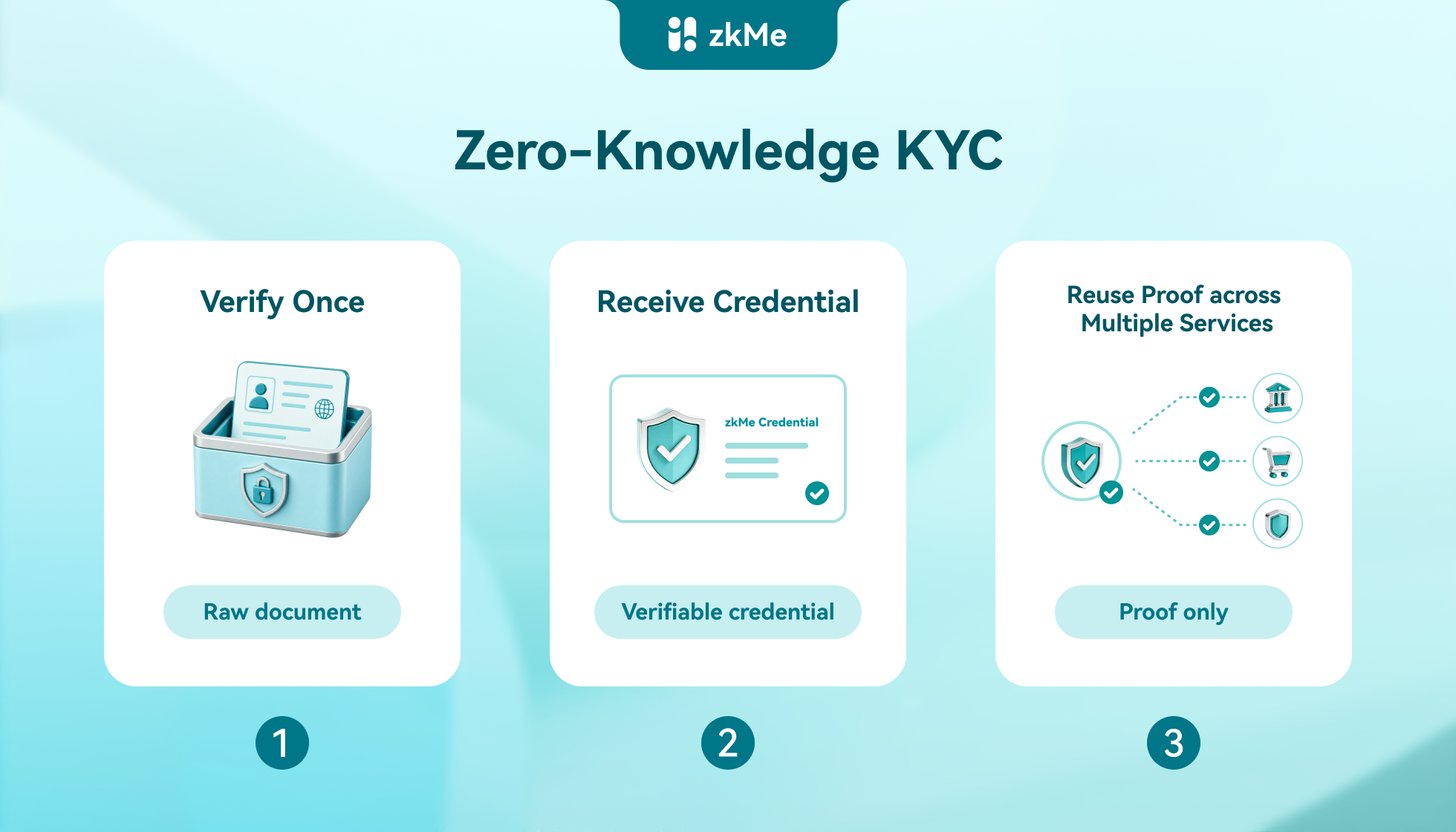
A user may need to prove they are above an age threshold, without exposing their full birthdate. They may need to prove residency in an approved country, without disclosing a home address. They may need to prove account ownership, investor eligibility, or other regulated status, without turning every verification step into another document transfer event.
From a zk perspective, this is the part that makes the model worth building. Zero-knowledge proofs let us separate verification from disclosure. That is a big step forward for privacy, but it is also a big step forward for system design. The relying party can trust the claim without becoming the long-term custodian of everything behind it.
Why reusable credentials matter
There is another weakness in the traditional model that gets less attention than it should: repetition.
Users keep proving the same things. They upload the same documents to different platforms. They re-enter the same onboarding funnel for each new product. Even when the underlying fact has not changed, the process starts from scratch because the system was never designed for portable trust.
Reusable credentials change that.
Once a fact has been verified and turned into a secure credential, the user can present proof of that fact again in a different context. The verifier does not need to rebuild the whole process every time. The relying party does not need to ingest the full underlying record every time. The user does not need to start from zero every time.
This is good for conversion, but more importantly, it is good for sanity. People should not have to keep scattering copies of their identity documents across the internet just to access normal services.
Reusable credentials also give platforms a more practical trust layer. Instead of treating every verification event as an isolated transaction, they can work with credentials that are portable, scoped, and better suited to repeated use.
Better trust usually leads to better UX
A lot of identity UX is bad for a simple reason: the system asks for more than the decision requires.
Users are told to upload sensitive documents, wait through opaque checks, and repeat the process whenever they move to a new service. That creates friction, but it also creates mistrust. People can tell when the exchange feels too broad.
Proof-based verification makes the flow easier to explain and easier to accept. The user can see the logic. Prove the specific thing this service needs. Share the minimum. Keep the underlying data under tighter control.
That produces a better experience in obvious places like financial onboarding, but it also matters in credential platforms, account recovery, access gating, high-trust marketplaces, and any system where identity is necessary but broad disclosure is not.
This is one reason we think zero-knowledge verification has legs beyond niche technical audiences. The underlying cryptography is advanced. The user benefit is simple.
How zkMe approaches this
At zkMe, we work from the view that identity should function as infrastructure, not as static paperwork passed from system to system. That is why our work centers on zero-knowledge proofs, selective disclosure, reusable credentials, and verification models that reduce raw data exposure.
In practice, that means platforms can verify what they need without defaulting to document custody. It means users can retain more control over what they share. It means identity checks can feed into broader product flows like eligibility, access, financial data proofs, and other trust-sensitive actions without dragging the whole underlying record along with them.
The deeper point is that zkKYC should not be framed only as "traditional KYC, but more private". Done properly, it changes the structure of the exchange. It moves the system toward verifiable claims, portable credentials, and tighter data boundaries. From a technical standpoint, that is a better foundation.
What comes next
Proof-based verification will not replace every verification workflow tomorrow. Some processes will still require richer review, ongoing monitoring, or jurisdiction-specific controls. That is fine. The point is not that all identity systems suddenly become zero-knowledge systems overnight.
The point is that the default answer is starting to change.
When a platform only needs to know whether a condition is true, it should ask why it still needs to hold the full underlying data. In more and more cases, it does not.
That is the shift we keep coming back to. Identity systems do not need to scale by multiplying copies. They can scale by improving proofs, tightening disclosure, and making verified facts reusable across contexts.
Once that becomes your starting point, the buying question changes too. It is no longer just "Who can verify this user", it is "What are we taking custody of after the check, and do we really need it".
That is the better question. It leads to better systems.
About zkMe
zkMe provides protocols and oracle infrastructure for the compliant, self-sovereign, and private verification of Identity and Asset Credentials.
It is the only decentralized solution capable of performing FATF-compliant CIP, KYC, KYB, and AML checks natively onchain, without compromising the decentralization and privacy ethos of Web3.
By combining zero-knowledge proofs with advanced encryption and cross-chain interoperability, zkMe enables verifiable identity and compliance data to remain entirely under the user's control. This ensures that sensitive information never leaves the user's device while maintaining regulatory-grade assurance for partners and protocols.


