


The case for checking age online usually starts with a reasonable aim: children should not be exposed to products and content that are not meant for them.
The objection is reasonable too. If social platforms must check the age of every user, adults may have to identify themselves before they can read, post, or join a conversation. A rule designed for child safety could leave everyone with another identity trail.
That concern should not be waved away as hostility to safety or technology. Once age checks move into social platforms, app stores, devices, or operating systems, they start to look less like a one-time gate and more like shared identity infrastructure. The design choices made now could determine how much of our offline identity follows us around the internet.
There is a narrower option. A service can verify that someone meets an age threshold without receiving the identity record behind that fact.
Why age verification can become a barrier to online speech
Social media is where many people follow news, keep up with friends, find communities, and speak in public. Requiring an identity-linked check changes that experience even if nobody removes a single post.
People behave differently when they think an account can be tied back to a legal identity. Some will avoid sensitive subjects. Others will leave communities that matter to them. People without accepted documents, and those wrongly classified by age-estimation systems, may lose access altogether. Journalists, abuse survivors, activists, and anyone who keeps a deliberate boundary between their civil identity and online voice have more at stake than a few minutes of onboarding friction.
This is often described as a free-speech objection, but it also concerns the conditions for participation. An age rule should not quietly become a requirement to obtain an identity-backed licence to read and post online.
Private age assurance cannot settle the political question of which restrictions are justified. It can limit the identity power created when a platform enforces those restrictions. If a check must take place, it should not give the platform a reusable link between a person, an account, and everything that account says or follows.
What personal data does age verification actually need?
An over-16 rule requires a small piece of information: does this person meet the threshold?
The platform does not need a legal name to answer that question. It does not need an exact birthday, home address, document number, or image of a passport. Yet many familiar verification flows collect some or all of those details because the document has become a substitute for the decision.
Even a promise to delete the document later leaves gaps. Who processed it? What logs remain? Can separate checks be linked? Does an intermediary learn every service a person visits? A stable identifier can become a tracking handle without displaying anyone's name.
A better request is specific: prove that the rule is satisfied. The response should be just as specific. It should answer yes or no for that service and that moment, without handing over the evidence underneath.
How privacy-preserving age verification works
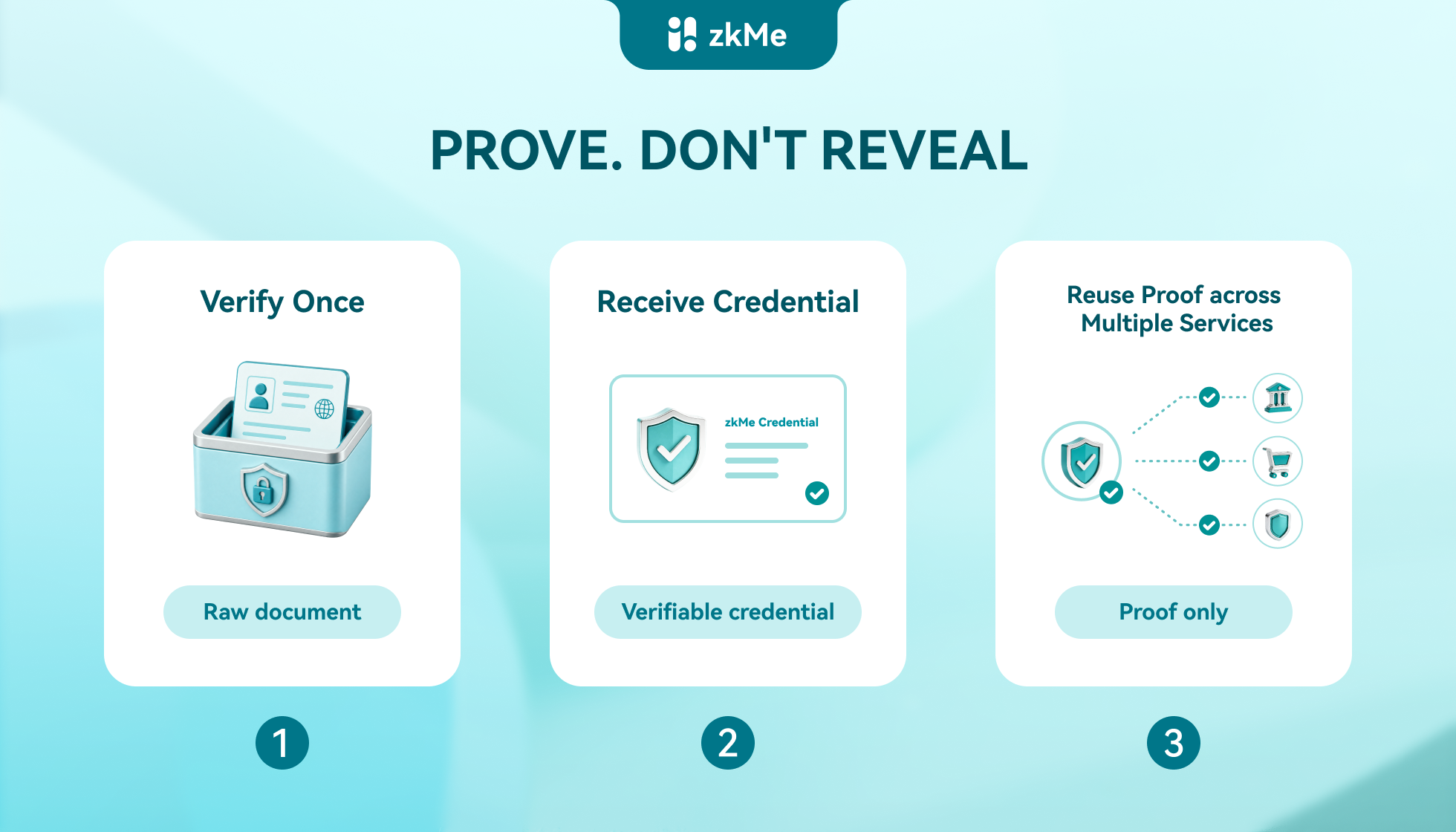
A trusted source confirms the age information and issues a credential. The user keeps that credential rather than uploading the source document to each new platform. When a platform asks whether the user is over 16, the user's device generates a proof for that request. The platform checks the proof and receives the threshold result.
It does not receive the birthday or the original document. A well-designed proof also avoids a stable identifier that follows the user between services. The issuer should not receive a live record of where the proof is shown, or what the person does after entering.
The source can stand behind the fact without joining every interaction. The platform can apply its rule without becoming an identity warehouse. The user keeps the rest out of the transaction.
How zero-knowledge proofs verify age without revealing identity
Zero-knowledge proofs give this model technical teeth. They can prove that a statement is true, such as "the holder is at least 16," without revealing the date of birth or identity record used to establish it.
Selective disclosure follows the same principle. Instead of opening an entire credential, the user reveals the one claim a service needs. This is stronger than asking a platform to collect everything and delete the unnecessary parts later. The platform never receives those parts in the first place.
For people worried about speaking under an identity check, that difference is meaningful. A threshold proof can reduce the need to bind a social account to a civil identity. It can also make cross-service tracking harder if each proof is scoped to its context and designed to be unlinkable.
Still, "uses ZK" is not a privacy guarantee.
Cryptography cannot decide whether an age restriction is proportionate. It cannot stop a government or platform from applying checks to more services. It cannot make an issuer fair, fix every classification error, or provide documents to someone who lacks them. A badly designed proof can still be linkable. Logs and metadata can reveal patterns that the proof itself hides.
ZK can reduce disclosure. Governance, implementation, and user choice determine whether the full system respects that limit.
What makes an age verification system privacy-preserving?
Users should not have to take a provider's privacy claims on faith. A credible system should be able to answer a few direct questions:
- Does the platform receive or keep any raw identity document?
- Does it learn the exact age, or only whether the threshold is met?
- Can proofs shown to different services be linked to the same person?
- Can the issuer see where and when someone uses a proof?
- Can the proof connect a civil identity with posts, follows, or group membership?
- What happens when the system is wrong, a credential expires, or a user has no accepted document?
- Can users choose between issuers or verification methods, or is one provider the compulsory gatekeeper?
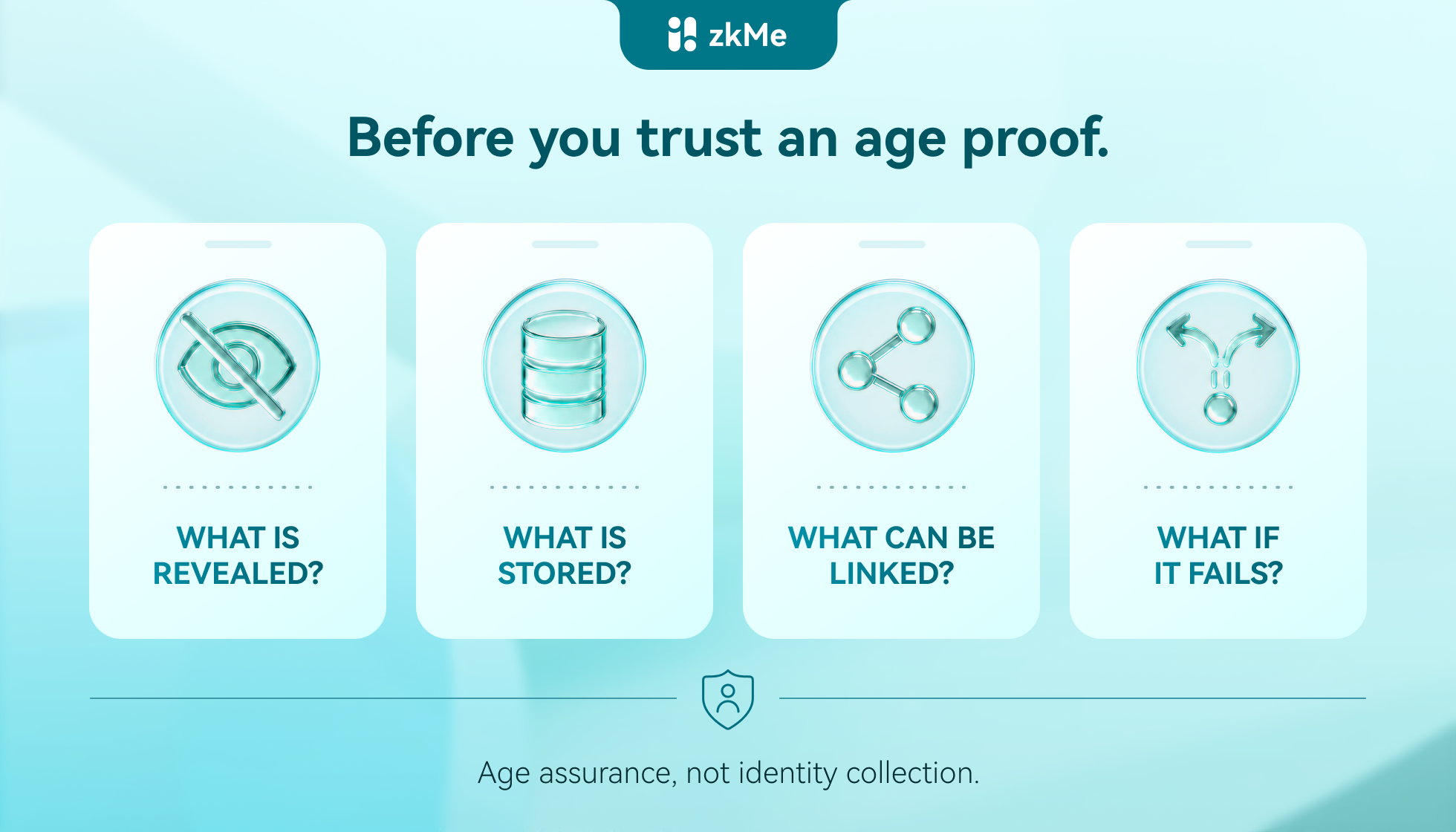
These are product questions as much as policy questions. "We do not store passports" is a start. It says nothing about linkability, usage logs, appeals, or whether an age token becomes a general-purpose identifier.
Beyond age verification: prove eligibility without exposing identity
The same minimization rule can reduce exposure in other checks that already exist. A person might prove that a service is available in their jurisdiction without sharing a home address. They might prove account ownership without exposing transaction history, or show that a required eligibility check was completed without sending raw documents to another platform.
Applying this rule elsewhere should reduce disclosure, not expand identity requirements. It belongs only where a check already exists.
At zkMe, this is how we think about privacy-preserving credentials and proof-based verification. Platforms often need confidence in a specific claim. They rarely need custody of the full identity behind it. Selective disclosure and user-held credentials can keep those two things separate.
The same standard applies to us. A proof should answer the service's question and then stop. It should not become a key that connects identity to speech.
The policy argument will not disappear, and technology cannot settle it. But technology can prevent a narrow age question from automatically becoming a full identity handover.
About zkMe
zkMe provides protocols and oracle infrastructure for the compliant, self-sovereign, and private verification of Identity and Asset Credentials.
It is the only decentralized solution capable of performing FATF-compliant CIP, KYC, KYB, and AML checks natively onchain, without compromising the decentralization and privacy ethos.
By combining zero-knowledge proofs with advanced encryption and cross-chain interoperability, zkMe enables verifiable identity and compliance data to remain entirely under the user's control. This ensures that sensitive information never leaves the user's device while maintaining regulatory-grade assurance for partners and protocols.


