


Two worlds, same wishlist
Institutional DeFi and permissionless neobanks often appear to sit at opposite ends of the financial spectrum.
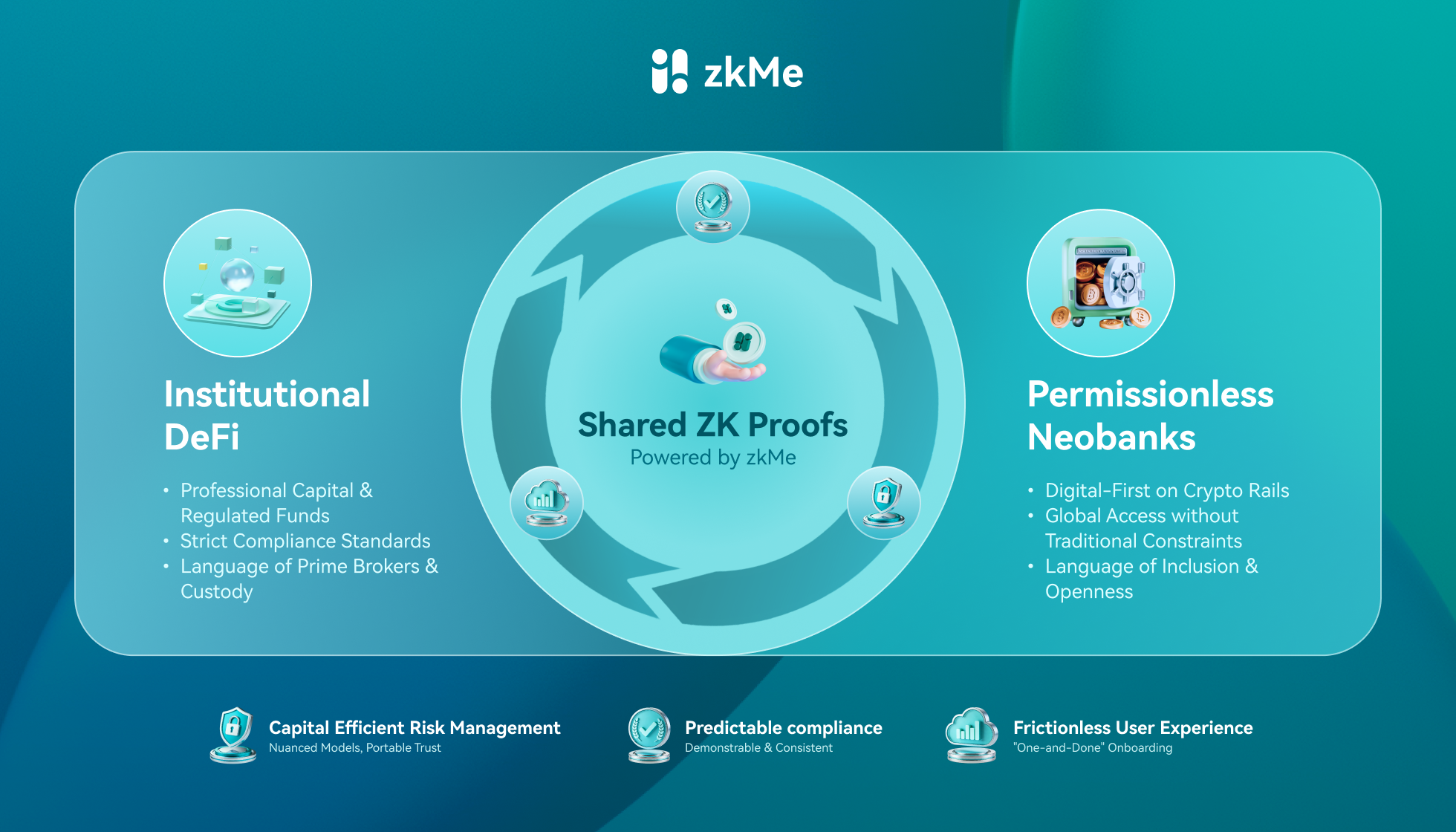
Institutional DeFi refers to onchain markets and protocols designed for professional capital. Think regulated funds, market makers, and treasury desks interacting with smart contracts while maintaining strict compliance standards.
Permissionless neobanks, by contrast, are digital-first financial platforms built on crypto rails. They offer payments, savings, lending, and access to global markets without the constraints of traditional banking infrastructure.
One speaks the language of prime brokers and custody. The other speaks the language of inclusion and openness.
Yet strip away the branding and both are chasing the same three outcomes:
- Predictable compliance
- Capital efficient risk management
- User experience that does not alienate users
The difference is not in what they want. It is in how they are trying to get there.
Predictable compliance
For both institutional DeFi venues and permissionless neobanks, the most important feature is not yield or growth. It is the absence of unpleasant surprises.
Regulators want clarity. Auditors want consistency. Banking partners want confidence that onboarding and monitoring standards are stable and defensible.
Today, that predictability is difficult to achieve.
KYC processes are fragmented. Policies vary across jurisdictions. A user verified in one product must often repeat the same process in another. Even within a single organization, standards can drift between teams and regions.
The result is friction and operational risk.
A shared zero knowledge identity layer changes the dynamic. Instead of each platform building its own compliance stack from scratch, identity and eligibility can be expressed as cryptographic proofs. These proofs can be verified the same way everywhere, regardless of the underlying chain or application.
The venue retains control over its policies. What changes is the format in which compliance is enforced. Instead of passing around raw documents and sensitive data, participants present proofs that specific conditions are met.
Compliance becomes something that is demonstrable, portable, and consistent.
Predictable compliance stops being a cost center and becomes infrastructure.
Capital efficient risk
Capital efficiency is often discussed in terms of collateral ratios and liquidity design. But a quieter inefficiency runs through both institutional DeFi and permissionless neobanking.
Over collateralization locks up capital. Repeated KYC processes slow down deployment. Conservative limits apply uniformly because platforms lack granular information about counterparties.
When risk cannot be measured precisely, it is managed bluntly.
Reusable proofs offer a different path.
If identity, asset ownership, and reputation can be expressed as verifiable credentials, then risk models can become more nuanced. A counterparty with a strong compliance profile and clean onchain history can access higher limits. A long standing user can move capital across venues without restarting from zero. A new product launch does not require rebuilding trust from scratch.
Capital rotates more freely because trust is portable.
This does not mean lowering standards. It means applying them with greater precision.
For institutions, that translates into better balance sheet utilization. For neobanks, it enables product expansion without freezing liquidity behind repetitive checks.
UX users do not hate
In theory, digital finance is frictionless. In practice, it often feels repetitive and slow.
Users upload the same documents multiple times. They wait days for approvals. They repeat onboarding when moving between platforms that serve similar functions.
For institutional desks, the process is dressed in enterprise language. For retail users, it is framed as onboarding. The underlying experience is similar.
A single zero knowledge credential can change this dynamic.
Once verified, a user can prove eligibility across applications without resubmitting raw data. Internal risk systems can still apply their own thresholds. Regulators can still require evidence. But the interaction shifts from document exchange to proof verification.
Onboarding becomes closer to one and done.
The goal is not to remove compliance. It is to remove redundant friction.
In a competitive market, user experience is not a cosmetic concern. It determines who scales.
The unifying layer: shared zk proofs
At the center of this convergence sits a shared identity rail.
zkMe's zk identity infrastructure allows users to generate cryptographic proofs of attributes such as residency, accreditation, or asset ownership without exposing underlying data. These proofs can be verified across apps, chains, and jurisdictions through standardized verification logic.
Each venue defines its own policies. The proof system simply ensures that when a condition is satisfied, it can be demonstrated in a consistent and privacy preserving way.
Control over policy remains local. Data exposure becomes minimal. Verification becomes interoperable.
This is what allows two different financial models to rely on the same trust substrate.
What this enables in practice
The implications become clearer in real scenarios.
An institutional desk trading across multiple DeFi venues can verify eligibility once and reuse that credential across protocols. Risk teams maintain oversight. Capital moves without repeated onboarding cycles.
A permissionless neobank entering a new region can adapt its compliance policy to local requirements while relying on the same underlying proof format. Expansion becomes a matter of policy configuration rather than rebuilding identity infrastructure.
A user who has built a strong reputation in one application can carry that reputation into another. Access to higher limits or premium features reflects verifiable history rather than siloed records.
In each case, the shared element is not the product. It is the proof layer.

Ready to build the Institutional DeFi or Permissionless Neobank?
Start with a zk-powered proof layer today!
Stop solving the same problem twice
Institutional DeFi platforms and permissionless neobanks often believe they are building distinct systems. In reality, they are re implementing compliance, risk management, and onboarding in parallel.
Both are investing heavily in plumbing that does not differentiate them.
A shared zero knowledge identity layer offers a different path. It allows platforms to compete on product design, distribution, and capital strategy while relying on common, verifiable foundations for trust.
The destination is aligned. Predictable compliance. Capital efficient risk. User experience that scales.
The question is whether these two worlds continue solving the same problem twice, or recognize that the infrastructure they need is already converging.
About zkMe
zkMe provides protocols and oracle infrastructure for the compliant, self-sovereign, and private verification of Identity and Asset Credentials.
It is the only decentralized solution capable of performing FATF-compliant CIP, KYC, KYB, and AML checks natively onchain, without compromising the decentralization and privacy ethos of Web3.
By combining zero-knowledge proofs with advanced encryption and cross-chain interoperability, zkMe enables verifiable identity and compliance data to remain entirely under the user's control. This ensures that sensitive information never leaves the user's device while maintaining regulatory-grade assurance for partners and protocols.


