


Most companies today claim to be "AI-Native." But if you look under the hood, very few actually are.
The common mistake across the tech industry is equating an "AI-Native" transformation with simply purchasing a few Cursor or Claude Code subscriptions for the engineering team. While giving developers access to AI coding assistants is a great start, it barely scratches the surface of what a true AI transformation requires. At zkMe, we believe that becoming genuinely AI-Native is not just a tooling change, it's a fundamental organizational restructuring. It requires process modeling, comprehensive training, and a complete reimagining of how work gets done.
After three months of rigorous implementation, we are proud to state with confidence that zkMe is now officially an AI-Native software company. Here is a look at what we built, how it works, and what we learned along the way.
Why "AI-Native" Is Misunderstood
If you scroll through LinkedIn or tech blogs, everyone is talking about the individual's journey toward becoming "AI-native." We hear endless discussions about prompt engineering, personal productivity hacks, and the best new AI tools for specific tasks.
However, there is a glaring omission in this conversation: almost no one is discussing what it means for an organization, not just a person, to be AI-Native.
When companies deploy AI tools without proper governance, process redesign, and cultural alignment, the result is often chaos rather than efficiency. Siloed tools lead to fragmented knowledge, inconsistent outputs, and security vulnerabilities. To truly harness the power of AI, a company must build a structural foundation that integrates AI into the very fabric of its operations.
Introducing Suna: zkMe's Internal AI Backbone
To solve this structural challenge, we built Suna—our new internal AI engineering backbone. Developed entirely in-house, Suna acts as a unified digital colleague for every human working at zkMe.
Suna's core responsibility is to orchestrate all engineering and operational activities. From understanding the intent behind a User Story, to applying design and product rules, to coordinating the entire development process through to testing, Suna is involved at every step.
To ensure accessibility across the entire company, Suna features two primary entry points:
- A Slack-like Digital Workspace UI for non-technical staff (Business Development, Product Management, HR).
- Direct IDE Integration for our development team.
How Suna Works: The Architecture
The true power of Suna lies in its underlying architecture, which is designed to be secure, extensible, and model-agnostic.
The AI Rules / Prompting Engine
When an employee interacts with Suna, the request first passes through our AI Rules/Prompting Engine. This routing layer is the brain of the operation. It applies the organization's "AI Work Charter" principles by validating permissions, classifying the type of task, and determining exactly which tool or data source is needed to fulfill the request.
Real-World Examples:
- Business Development
A BD team member asks, "Generate invoices from this month's spreadsheet." Suna seamlessly triggers a chain of services behind the scenes, handling Excel data analysis, PDF generation, and email automation without any manual intervention.
- Product Management
A PM asks, "Find related bugs from this error log". Suna instantly invokes a Git repository search and utilizes a MySQL Natural Language Query (NLQ) tool to query our databases and return the relevant information.
The MCP Layer (Model Context Protocol)
The magic that makes these complex workflows possible is the MCP layer. This acts as a universal translator between Suna and zkMe's existing infrastructure. Each MCP service encapsulates a specific capability—whether it is retrieving knowledge from Git repositories, querying business databases with natural language, interacting with the workspace for approvals, or generating dynamic Grafana dashboards.
The Knowledge Foundation
All of these services share access to a unified knowledge foundation. At zkMe, we use Git repositories as the single trusted source of truth for all company information, ranging from HR policies to technical specifications. As one industry peer noted, using GitHub for policies is the best version control system available for non-tech documentation.
Why This Architecture Matters
By decoupling the AI models from the underlying data sources, we have created a system that is both secure and extensible. This modular design means new tools can be added without disrupting the core platform. As zkMe grows, our capabilities can evolve in lockstep while maintaining strict governance and auditability. Most importantly, this architecture ensures we are never locked into a single AI model or provider.
The "AI Work Charter": Governance as a Feature
For a privacy-first company like zkMe, governance cannot be an afterthought. That is why we embedded our "AI Work Charter" directly into Suna's routing layer.
This charter is a set of organizational principles that dictate how AI can and should be used within the company. It ensures auditability, maintains strict security protocols, and enforces role-appropriate access to data and tools.
The broader lesson here is simple: AI adoption without governance is a liability. By formalizing our AI Work Charter, we didn't just add tools; we redesigned our process constraints to ensure that our AI transformation is safe, scalable, and aligned with our core values.
Early Results: What Has Changed
The impact of Suna has been immediate and measurable. Our early pilots have demonstrated significant improvements across the board:
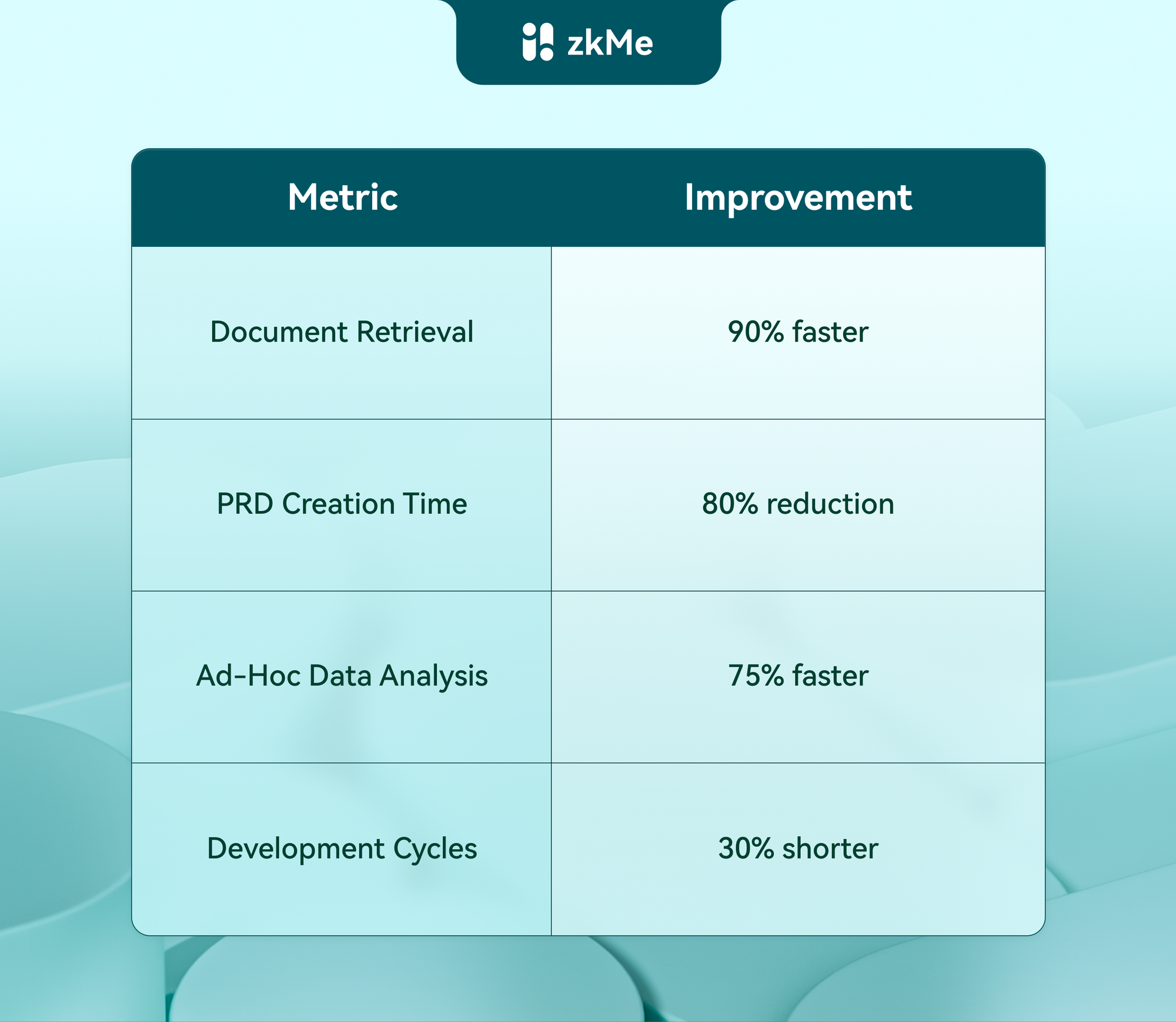
These numbers signal something profound: AI isn't just saving us time on individual tasks. It compresses the entire product and operations lifecycle, allowing us to move faster and build better products.
Key Takeaways for the AI Transformation Journey
If your company is embarking on its own AI transformation, here are the key lessons we learned during our three month implementation:
- It is a Company Transformation: Going AI-Native is an organizational shift, not an individual one. It requires process modeling, training, and implementation, not just tool access.
- Build for Governance from Day One: Implement an AI Work Charter model to ensure security, auditability, and role-based access.
- Embrace a Modular Architecture: A model-agnostic architecture (like our MCP layer) future-proofs your investment and prevents vendor lock-in.
- Centralize Your Knowledge: Your knowledge infrastructure (Git, wikis, docs) is your most valuable AI asset. Treat it as the single source of truth.
Conclusion
zkMe's transformation over the past three months is proof that being privacy-first, AI-Native, and operationally excellent are not mutually exclusive goals. By building Suna and restructuring our organization around it, we have created a unified, intelligent, and highly efficient digital workplace.
So, we ask you:
What does your company's AI transformation actually look like under the hood? Are you just handing out Cursor/Claude Code subscriptions, or are you fundamentally changing how your organization operates?
If you are interested in learning more about our journey or the technical details behind Suna, feel free to reach out. We are always happy to share our experiences as we continue to build the future of privacy-first, AI-driven software.


